04. Capital Ratio Stack: why bigger banks hold more capital
If you only know the 8%, you only know the floor.
#BankingRegulation #BaselIII #CapitalRatio #RiskManagement #BankingMetricsSeries
In 1988, every bank had to hold the same 8%. One number, one floor, identical for a small regional lender and a global systemic bank.
That model did not survive the 2008 crisis. The capital requirement now stacks several layers on top of the 8% floor, each answering a different question.
Pillar I: the universal floor. 8% of RWA, same for every bank in the world.
Pillar II (P2R): bank-specific. Set every year by the supervisor after their review, to capture risks the Pillar I formulas miss: concentration, interest rate risk in the banking book, stress testing results.
Capital Conservation Buffer (CCB): the rainy-day cushion. 2.5% to be built in good times. If the bank dips into it, the supervisor restricts dividends, AT1 coupons and bonuses until it is rebuilt.
Systemic Institution Buffer: The bigger and more interconnected the bank, the higher the buffer. Global systemic banks get a higher number set by the Financial Stability Board.
Countercyclical Buffer (CCyB): based on the credit cycle in each country where the bank lends. A bank with multi-country exposures computes a weighted average.
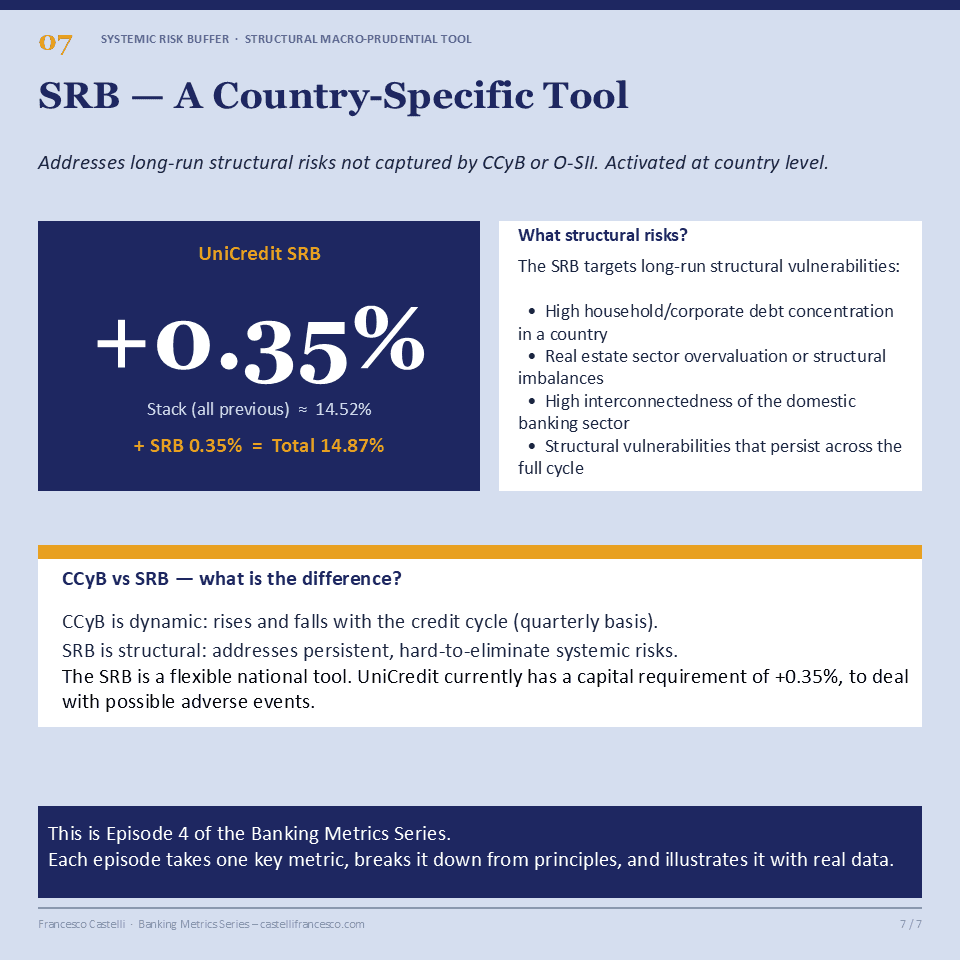
Systemic Risk Buffer (SRB): country-specific, addressing persistent structural vulnerabilities in the national banking sector.
The bigger the bank, the more interconnected, the more cyclical its lending book, the higher the stack.
UniCredit December 2025 ends up at 14.87% requirements.. Quite a big difference! A small Italian cooperative bank would sit much lower.
Each layer rebuilt in the carousel 👇