07. Deferred Tax Assets: the asset that disappears in a crisis
A Deferred Tax Asset is a real asset in good times and worth nothing in a crisis.
#BankingRegulation #BaselIII #CET1 #DeferredTaxAssets #RiskManagement #BankingMetricsSeries
A Deferred Tax Asset comes from two sources. Timing differences (taxes already paid that will reduce future bills) and loss carryforwards (past losses that offset future taxable income).
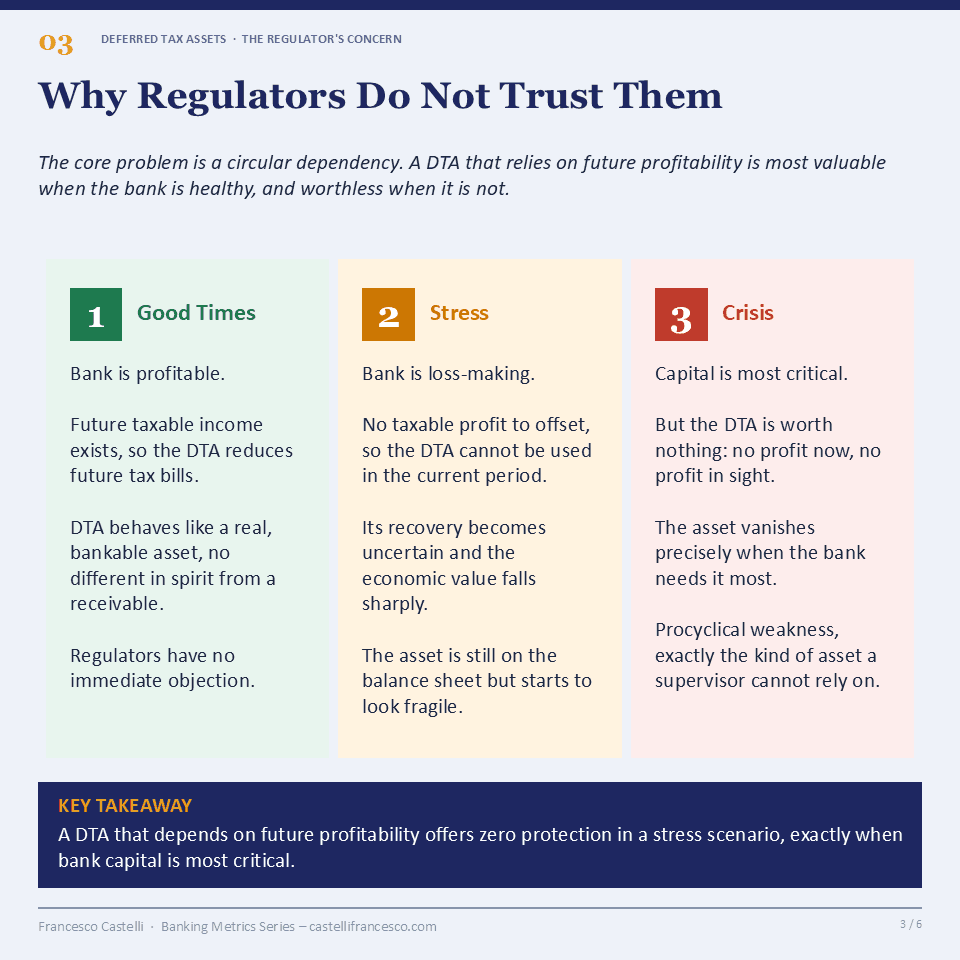
The catch is in the loss carryforward. It only has value if the bank returns to profit. In a healthy bank, the DTA is a real asset. In a stressed bank, it is worth less.
Procyclical asset, exactly when the bank needs capital most.
Basel regulations splits DTAs into two buckets:
Does not rely on future profitability: standard risk weight, no CET1 deduction.
Relies on future profitability: deduct from CET1, or 250% risk weight below the 10% threshold.
A 250% risk weight means 100 million euros of DTA consumes more capital than most senior corporate loans. It is a severe regulatory penalty.
The Italian DTA case (2013-2016) is the textbook example: Italian banks had accumulated some of Europe largest DTAs after the financial crisis. The Italian government passed legislation converting qualifying DTAs into tax credits, instruments recoverable even in loss-making years and acceptable as 0% risk-weighted assets. The EU Commission later objected. The case is still studied as a perfect storm of accounting, regulation, and politics.
The lesson is broader than DTAs. An asset on the balance sheet can be a hole in your capital stack if its value depends on a future that may not arrive.
Swipe through for the full framework 👇